200m/min
High-speed drying design target
Requires press-specific trials with the actual substrate and ink.
Hangzhou Yuehua · Water-based gravure drying
We design and adapt water-based ink drying systems around preheating, zoned airflow, moisture removal, heat recovery and heat-pump integration. Each proposal is evaluated against the press, web width, ink, substrate and site conditions.
Targets, rated configurations and historical field records are identified separately; final performance requires site verification.
Key design parameters
These are design targets and equipment configurations, not verified acceptance results for every press. Final capability depends on the material, ink, airflow and site conditions.
200m/min
Requires press-specific trials with the actual substrate and ink.
±0.05mm
Not a confirmed achievement or customer acceptance result.
35kW
Final heating capacity and operating sequence require engineering review.
65%
Actual field efficiency has not been verified and depends on structure and operating conditions.
≈6HP
Heating/cooling capacity and water temperature are subject to engineering calculation.
Diagnose first, retrofit second
Before quoting any kit, we measure what the oven is actually delivering against the job the line asks it to do.
Cross-check oven length, effective temperature, nozzle velocity, and per-color drying budget before turning any knob.
Confirm the wet-air path can keep up under humidity; in many plants this, not heat, is the real ceiling on speed.
Match the retrofit to web width, color count, ink system, and target speed; sometimes the answer is a process tweak.
Six coordinated technologies
Preheating, main heating, airflow, moisture removal and energy recovery are assessed together. The retrofit scope is set against the equipment on site.
Gradually warm the wet ink film before the main drying zone to reduce the risk of disturbance from high-velocity air.
Coordinate zoned supply air, return flow and exhaust to improve cross-web distribution and limit substrate disturbance; verify results on site.
The PLC concept links line speed, temperature, airflow and moisture removal. Control points and protective actions depend on the equipment and site review.
Nominal outside dimensions are about 50 × 50 cm, with 65% design efficiency. Effective ventilation area and actual efficiency require engineering verification.
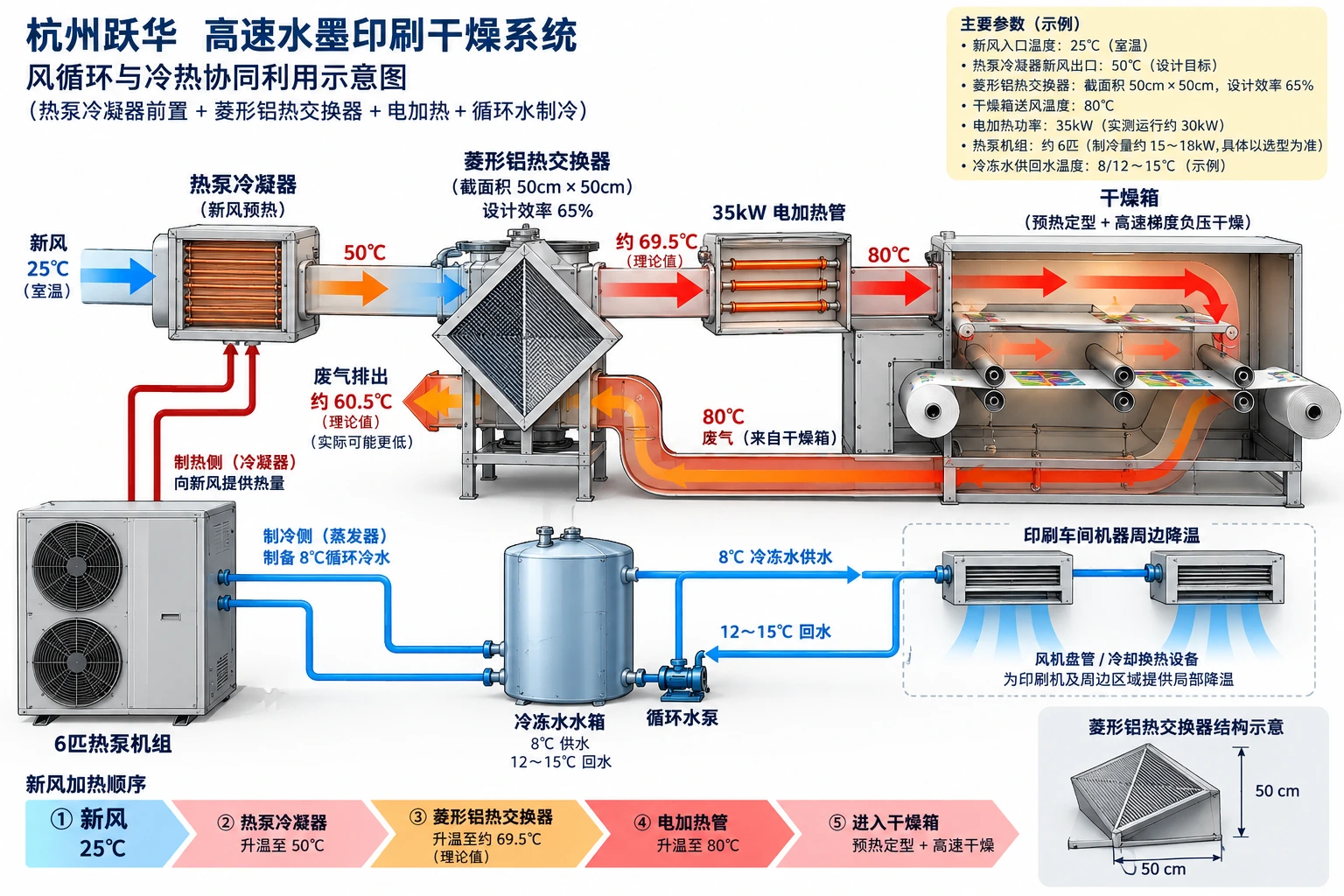
An approximately 6 HP heat pump can preheat fresh air through its condenser and serve a separate closed chilled-water loop through its evaporator. Capacity and water temperature require calculation.
The rated 35 kW main-heater configuration provides an independent heat source when heat recovery is insufficient or the heat pump is offline.
Drying electrical and automation system
This is a proposed PLC control framework: electric heat secures drying, the aluminum exchanger recovers exhaust heat first, and the heat pump responds to actual heating and cooling loads. Sensors, I/O points, thresholds and actions require equipment-specific engineering and a site safety review.
Coordinate fresh-air preheating with line speed and preheat-zone temperature to reduce excessive airflow disturbance before the ink film sets. Actual signals and actuators depend on the equipment.
Retain the rated 35 kW heater as the main heat source and temperature trim. The PLC can coordinate heater stages or power output using oven temperature and line speed where the installed hardware supports it; 80°C is an operating target example.
Coordinate zoned supply air, exhaust, negative pressure and moisture removal. Heating should be inhibited if fan operation or proven airflow is outside its permitted state; zone targets require site commissioning.
Use fresh-air and exhaust-side temperature and airflow signals to assess recovery, prioritizing available recovered heat. The 65% figure is a design value; actual performance needs verification under stable conditions.
The planned approximately 6 HP heat pump uses its condenser for fresh-air preheating and its evaporator for a separate closed chilled-water loop serving fan-coils near the press. Dispatch depends on usable cooling demand and a matching heat load; 50°C is a target to be calculated.
The protection design should cover overtemperature, fan or exhaust faults, insufficient airflow or water flow, and heat-pump faults, with defined heater cut-off, equipment stops and safe ventilation actions.
PLC energy dispatch examples
The controller may use line speed, oven-zone temperatures, exchanger conditions, heat-pump hot- and cold-side temperatures, chilled-water supply/return status and cooling demand around the press. Actual signals depend on the sensors, actuators and PLC configuration.
Confirm supply/exhaust fans and proven airflow before enabling heat; if heat-pump cooling is requested, also confirm the closed water loop.
Maintain process temperature, prioritize exhaust heat recovery and use the 35 kW heater to trim the remaining heat load.
Run the closed chilled-water loop and fan-coils; dispatch the heat pump according to cooling demand and usable condenser heat.
Unload or stop the heat pump without a useful heating/cooling load; enter the protection state defined by the safety review if a fault occurs.
Heating and cooling system
This is a functional flow illustration. Temperatures, airflow, equipment capacity and safety interlocks require engineering calculation for the actual equipment and site.
About · Hangzhou Yuehua
Hangzhou Yuehua Printing & Packaging Machinery Co., Ltd. traces its roots to Wenzhou Yaohua, established in 1992. For more than three decades, we have focused on R&D, manufacturing and field service for flexible-packaging gravure and laminating equipment, from earlier manual presses through today’s servo-driven electronic-shaft models.
As environmental requirements evolve, many printers are evaluating the move from solvent-based to water-based ink. Drying performance depends on more than oven temperature: airflow, moisture removal, substrate, ink and production conditions all matter.
Our water-based ink drying work has developed from heat-pump trials into a system approach covering heat, airflow, exhaust, heat recovery and control interlocks. We help printers assess equipment options for the solvent-to-water transition.
Equipment showcase
This illustrative 3D preview shows the general equipment layout, duct interfaces and service clearances. It is not a customer-site installation or acceptance video. Final configuration depends on your press model, web width, color count and site conditions.
Request a fit reviewIllustrative 3D equipment view · 5 seconds · not customer acceptance evidence
Field evaluation checklist
Technical topics
English technical briefs are being prepared. For a current line, send the six field data points and we will return the relevant diagnostic path first.
Start with drying capacity, exhaust balance, and process window before assuming the ink is to blame.
Request an English brief →Six field data points make the retrofit value and scope much easier to judge.
Request an English brief →Look at inlet air, exhaust balance, zoning, and material handling around a humid plant.
Request an English brief →Match airflow, temperature, exhaust, and heat recovery instead of chasing a single setting.
Request an English brief →Start the evaluation
Please include press model, color count, web width, current and target speeds, and the ink system you run or plan to run. We respond with a retrofit value and direction first, before any equipment quote.
For discussions on water-based ink drying, oven air path, or exhaust balance fit-up, please reach out by phone or WeChat.